
Railways in Great Britain
The Railway Network
The idea of the railway traces it origins to Roman times, possibly earlier, when stone paved roads were set with strips of long, smooth stones to accommodate chariot wheels.
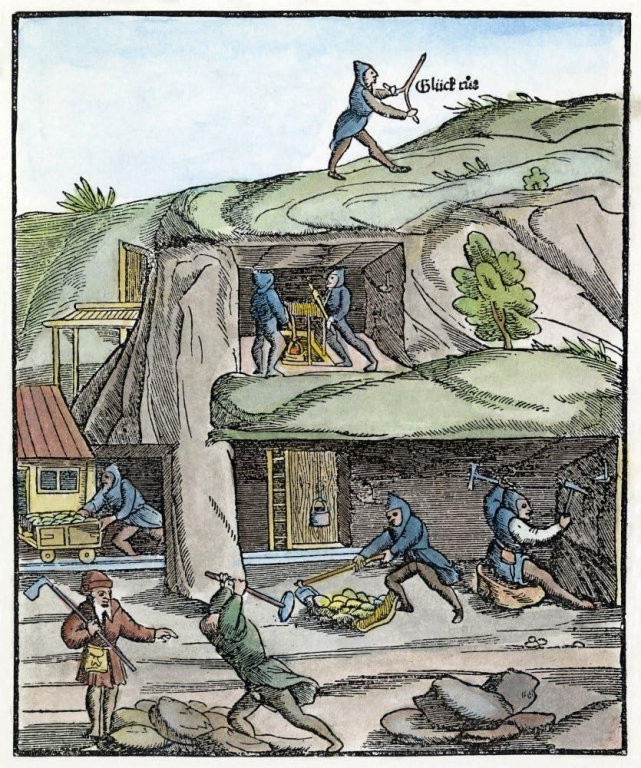
Engraving off a 16th century French or Swiss mine
showing a hand-propelled mine wagon running on wooden rails
By the 16th Century, even before the industrial revolution was fully under way, mining engineers used tramroads fitted with wooden rails, to ease the movement of loaded mine wagons (known as trams or drams). Early examples would have had no guidance system and the drams would have been steered by hand to keep them on the rails. Later examples had pegs fixed to the wagons running in grooves formed by parallel boards for guidance.
Around 1603 a tramroad was built to carry coal from mines near Strelley to Wollaton, near Nottingham. Innovatively, the rails were fitted with side boards so that they would guide normal wagon wheels. This is widely regarded as the first true railway in the world and is the earliest for which documentary evidence exists, although there are some indications that a similar line in Shropshire may have been earlier.
By the mid-17th Century tramroads were fairly common and continued to be so through the 18th century, so that by the start of the 19th Century they often ran for considerable distances, taking mineral products (notably coal) from their source to the point of consumption, or in some instances to a canal wharf for onward carriage by boat. At that time, the wagons were hauled by horses but, in 1804, Richard Trevithick demonstrated the first practical steam locomotive engine. By 1812, steam haulage was in regular commercial service on the Middleton Railway, near Leeds.
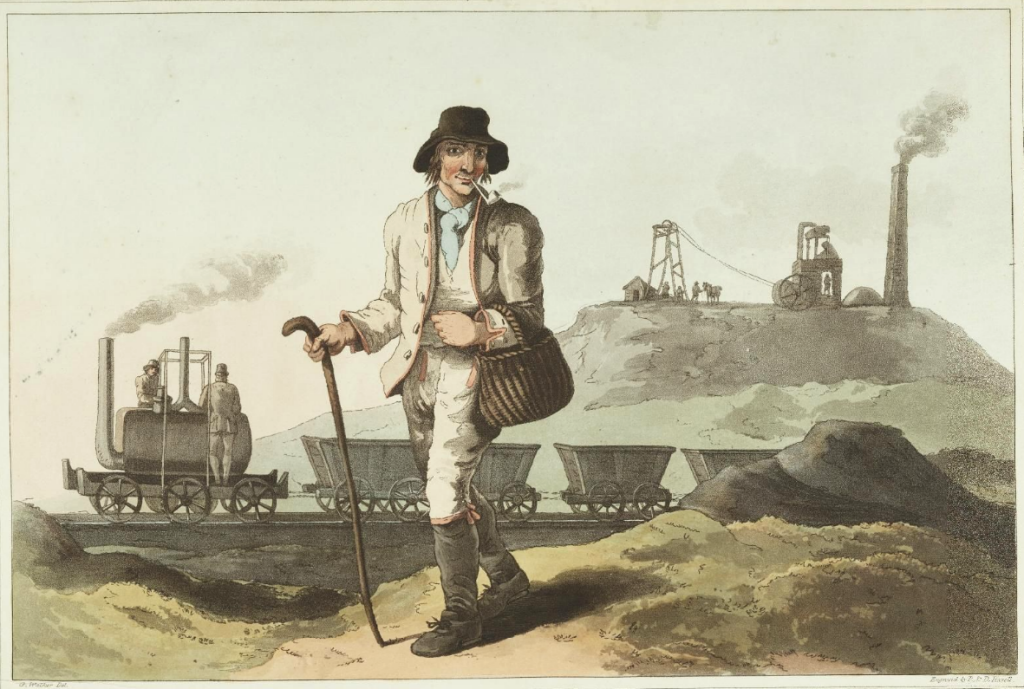
Middleton Colliery, near Leeds, with a train
hauled by Blenkinsop’s locomotive Salamanca
The first public railway as we know it today carrying passengers and freight was the Stockton & Darlington Railway in 1825. By 1839, when the Midland Counties Railway became the first railway to reach my home town of Derby, a considerable mileage of lines was already established around the country.
Railway development in Great Britain was piecemeal, each line being promoted by a private company. Serveral large, long distance operators did exist, and these did take over some of the smaller branch lines, but by the early 20th Century the country was still covered by a patchwork of small railway companies.
After the First World War, economic pressures forced many small railways into decline. The Government felt obliged to take action, but the political mood at that time was not in favour of state ownership of the railways, even though that expedient had been tried with some success in other countries. Instead, in 1923 almost all the railways in the country were grouped into four new companies (the “Big Four”):
– The Great Western Railway (GWR)
– The London, Midland & Scottish Railway (LMS)
– The London & North Eastern Railway (LNER)
– The Southern Railway
The Second World War took another great toll on the railways and on the state of the national economy in general, with the result that in 1948 the railways were nationalized as British Railways.
In the mid-1950s plans were put in hand for extensive modernization of the railways, but by the early 1960s it was clear that many rural railways had outlived their usefulness and would have to go. The result was the infamous Beeching Report of 1963 which led to widespread closures over the next few years. Undoubtedly the Report had its flaws (one could cite the apparent absurdity of closing one of the most modern lines in the country, from Manchester to Sheffield via Woodhead, or the withdrawal of passenger services from Mansfield to leave it the largest town in the UK, probably in Europe, without a passenger train service, just to name two examples) but it did have the desired effect of pruning out much of the “dead wood” from the network. Contrast the situation in France, where rural branch lines have died out by a slow, painful and expensive process of attrition, with much the same end result.
Meanwhile, British Railways was relaunched with a new image as British Rail, and modernization continued. Steam was phased out by the end of the 1960s in favour of diesel and electric traction.
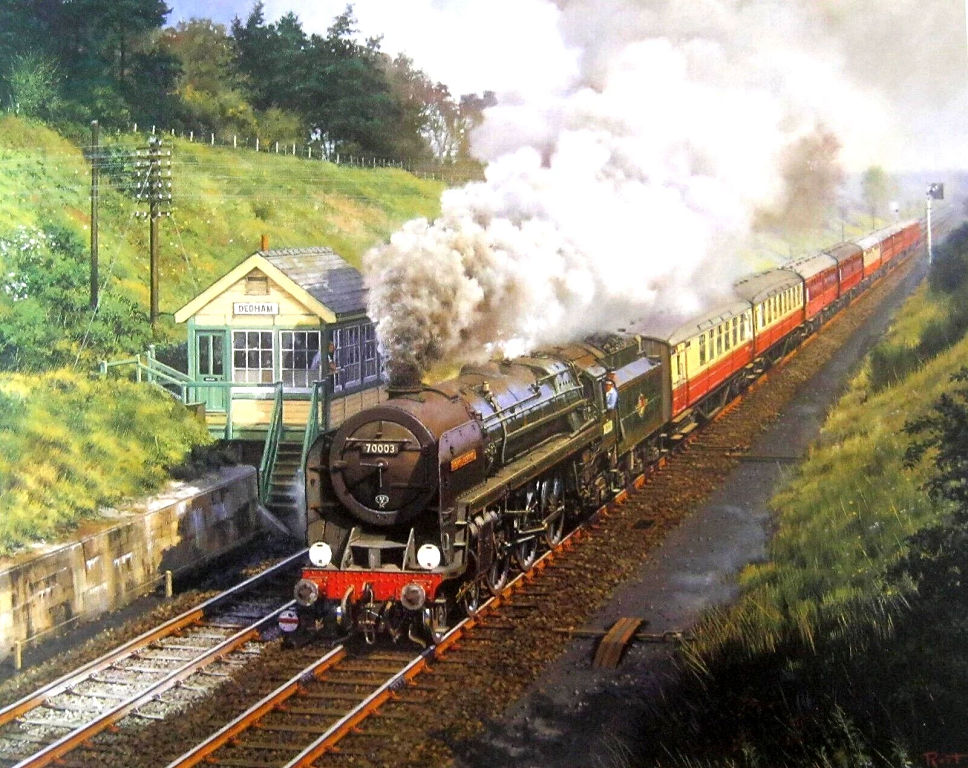
Britannia class locomotive 70003 John Bunyan
passing Dedham signal box in Essex with a train of ex-LNER coaches
in the 1950s, considered by some to be the heyday of British Railways
Railway Industry
As a pioneer in the introduction of railways, Britain became a world leader in railway industry. Even today, Britain’s railway products have a strong and respected place in the world market.
Locomotives and Rolling Stock
As a pioneer in the introduction of railways, Britain became a world leader in railway industry. Even today, Britain’s railway products have a strong and respected place in the world market.
In the early days, locomotives and stock were supplied by private companies such as that founded by Robert Stephenson. However, most of the major railway companies in Great Britain soon had their own locomotive, carriage and wagon works. The private companies survived by supplying to industrial lines and overseas railway companies. This situation prevailed into the 1950s, British Railways having inherited an extensive works capacity from the “Big Four” companies.
The 1955 Modernization Plan called for a huge program of diesel and locomotive manufacture, which was not only beyond the capacity of the British Railways works but also to an extent outside the sphere of expertise of works conceived in the steam age. The works were modified to cope with the new traction, but this could not happen fast enough for the modernization plan and many locomotives were ordered from private manufacturers: Brush, Beyer Peacock, Birmingham RCW, English Electric, Metropolitan Vickers and North British, to name a few. Diesel and electric multiple units came from the British Railways works, and from private manufacturers such as Birmingham RCW, Gloucester Carriage & Wagon and Metropolitan Cammell.
As part of the preparations for privatization, the British Rail works were formed into a new company, British Rail Engineering Limited, later simply Brel Limited. Industry generally was hard hit during the run up to privatization, because there was little or no investment in equipment. Many firms closed down or left the industry altogther, Brel itself was reduced from a dozen or so sites around the country to just a handful.
In the 1990s, things started looking up with inward investment from multinational companies. Brel became part of ABB, a consortium of Swedish ASEA and Swiss Brown Boveri. The famous Metropolitan Cammell works at Washwood Heath near Birmingham were acquired by Alstom, while the York works of Brel were sold to the American freight vehicle manufacturer, Thrall Car, later to become part of Trinity Industries.
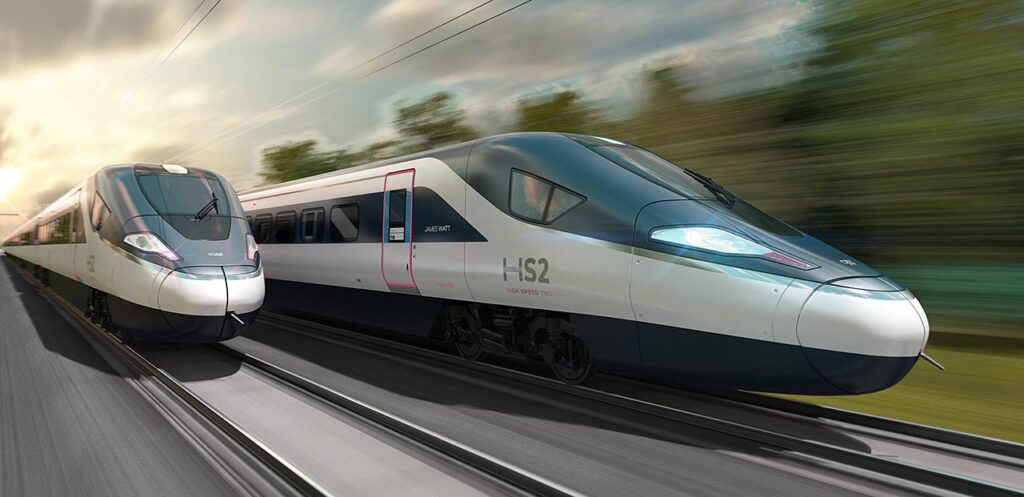
Artists impression of new trains for High Speed 2.
These will be built by a consotium of Hitachi and Alstom
In the early 21st Century a number of events combined to conspire against a proposed rapid development of the UK network. With a shrinking UK market, the multinationals pulled out, leaving Bombardier Transportation, who had purchased the ailing ABB, as the only major British rolling stock supplier. Bombardier passed to Alstom in 2021, but in the meantime CAF, Hitachi, and Siemens had all opened new rolling stock plants in the UK.
Sinalling
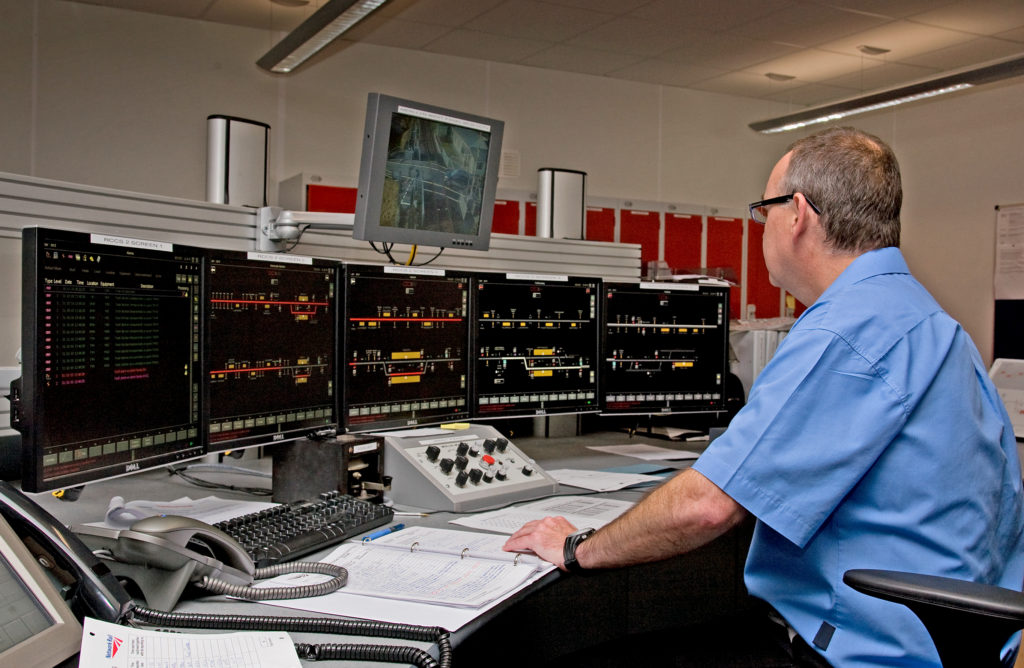
The ETCS (European Train Control System) centre at Machynlleth controlling the Cambrian Line
Famous names in early railway signalling such as Saxby & Farmer and Mackenzie & Holland are no longer with us, nevertheless Britain has had a vigorous, succesful and innovative signalling industry with a continuous history dating back to the 19th Century.
British companies continued to play a major role in signalling throughout the 20th century, developing from mechanical levers, through relay controlled power signalling, to computer control of signals and points. Signalling will always remain an important railway function, although in future it may become less visible to the general public as lineside signals gradually disappear to be replaced by in cab signalling.
Research
British Rail Research was always recognized as a world leader in cutting edge railway technology. Privatization led to its breakup, but their followed a proliferation of small consultancy firms retaining and building upon much of the former expertise. Many of these are now based in Derby, the former location of British Rail Research.